

Predict. Protect. Prevail: Lessons from Dharali’s Flash Flood
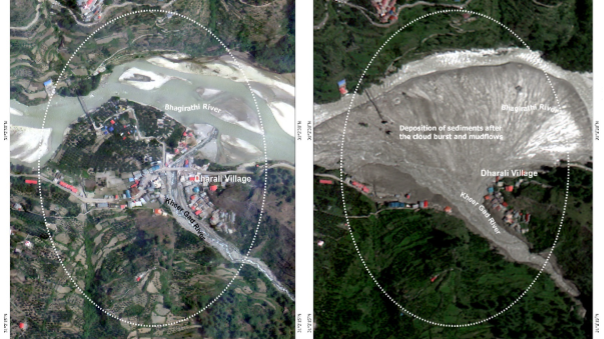
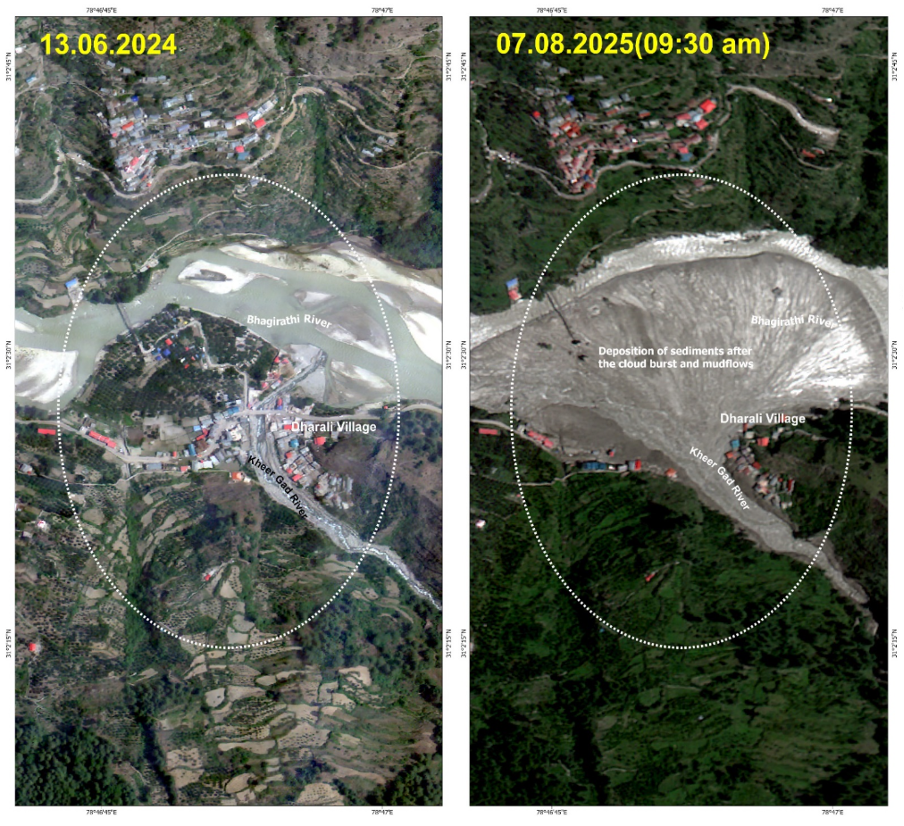
On August 5, 2025, Dharali village in Uttarkashi was hit by a sudden flash flood. Within minutes, torrents of water, boulders, and debris tore through homes, roads, and bridges.
The community’s bravery was remarkable. But Dharali is a reminder of a deeper truth: Resilience is not just about recovery. It is about readiness before disaster strikes.
What Happened
The primary trigger is believed to be a cloudburst. Other possibilities include the breach of a landslide-formed lake or a Glacial Lake Outburst Flood (GLOF).
Here is the anomaly: Rainfall measured less than 20 mm across three stations. This is too little to fully explain the disaster.
Geography played its part. Dharali sits in a narrow Himalayan valley, right beside a river. This is beautiful in calm times but dangerous in extreme weather.
Mudflow impact: 15 hectares Of this, 6.5 hectares covered by settlements and community structures were hit directly.
Why This Matters Now
Why Early Warning Fell Short
Existing tools and systems did not detect the risk in time. Without accurate asset-level risk maps, residents had no clear basis for evacuation or damage mitigation.
What We Did
At Resilience AI, we deployed Resilience360™ providing hyper-local physical risk assessment using artificial intelligence (AI), machine learning (ML) and multi-variate scientific evidence.
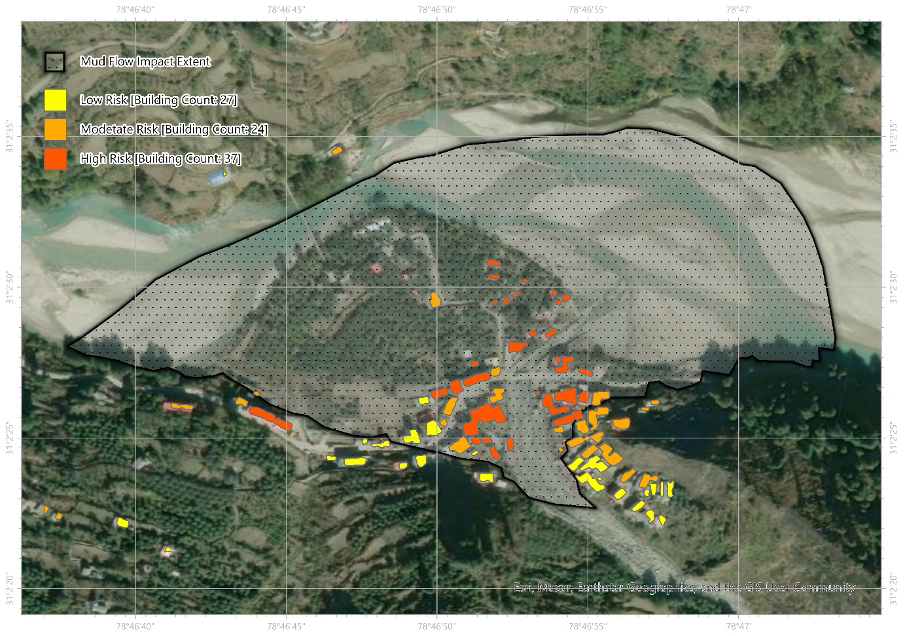
The platform analysed every building in Dharali and assigned a risk score (1 to 5) without a manual survey. Accuracy was 94.5 percent in identifing high risk homes
Pre-event profile of an area of less than 1 square kilometer
- High Risk – 37 buildings severely damaged or destroyed
- Moderate Risk – 24 buildings partially damaged
- Low Risk – 27 buildings largely unharmed
Why This Matters
Resilience360™ makes localised risk assessment fast, scalable, and actionable. In Dharali, this means we could:
- Prioritise evacuation for the most vulnerable homes
- Guide safe rebuilding in lower-risk areas
- Direct infrastructure upgrades to where they matter most
- Align financing / funding to actual risk exposure
The takeaway: Disaster resilience is not only about protecting assets. It is about protecting lives, livelihoods, social fabric of communities
Disclaimer: Resilience AI Solution Pvt. Ltd., makes no representations, warranties or guarantees – neither express nor implied – regarding 100% accuracy of the information. The users shall assume complete responsibility for any decision based on information in Resilience360. The users are responsible for independently verifying the critical information obtained by the usage of Resilience360 before relying on it for decision making purposes. To the fullest extent permitted by the applicable law, Resilience360 disclaims all liability for any direct, indirect, incidental, consequential, or special damages, including but not limited to economic losses, lost profits, loss of business opportunities, or reputational harm, arising from the use of or reliance upon information